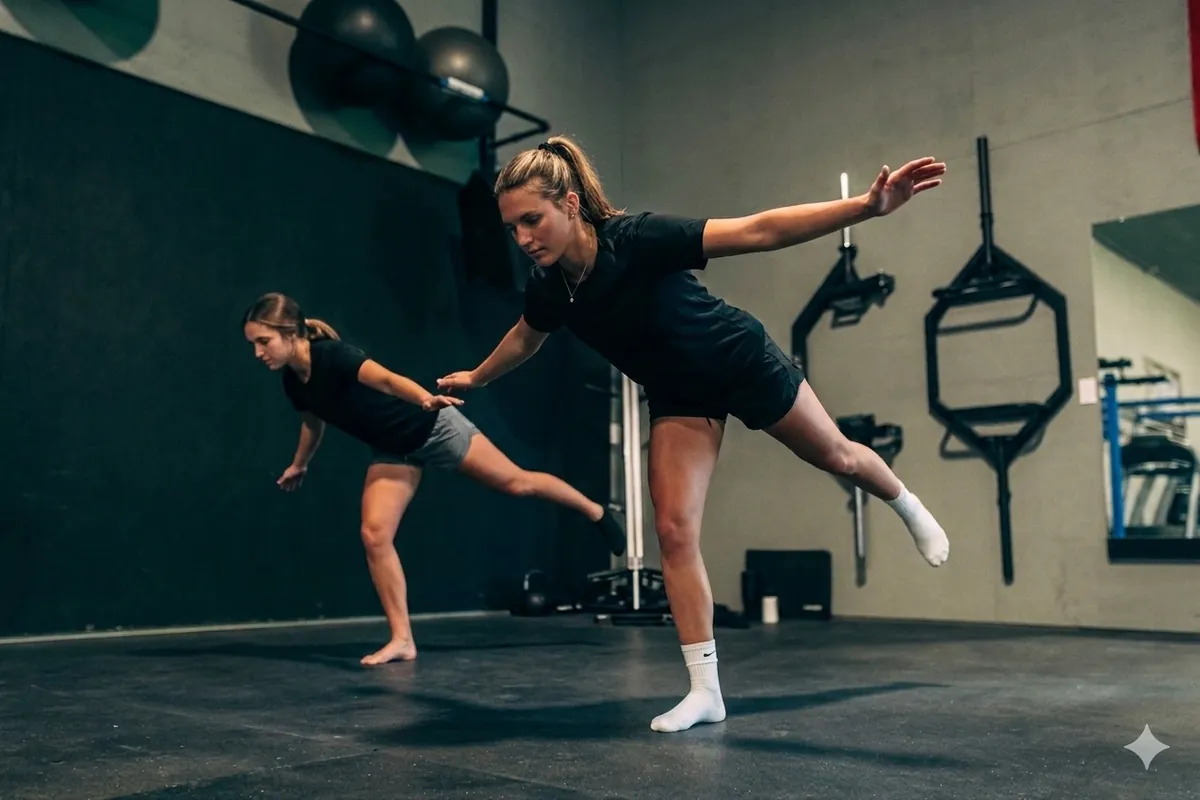
Cheerleading requires explosive lower-body power for tumbling, significant upper-body and core strength for stunting and basing, and precise landing control to avoid injury, demands that are comparable to gymnastics and volleyball. Most cheer athletes never get access to strength training built around these specific demands, which leaves both performance and injury prevention on the table.
Cheerleading gets left out of the conversation about athletic strength training more often than almost any other sport, despite asking as much of an athlete's body as gymnastics or volleyball. Tumbling passes require explosive lower-body power. Stunting and basing require real upper-body and core strength to lift, hold, and catch another athlete's full body weight. Landings, over and over, require control that most training programs never address directly.
Part of the gap is cultural, cheer is still frequently treated as an activity rather than a sport in how it's trained. But the physical demands don't care about that distinction, and the injury data backs that up: cheerleading carries one of the higher injury rates among high school sports, much of it landing- and stunt-related.
What Does Tumbling Actually Require Physically?
Explosive power production similar to what a gymnast or high jumper needs, the ability to generate force quickly through the legs and hips and transfer it into height and rotation. Athletes who never train explosive power directly, only tumbling reps themselves, tend to plateau because the skill work alone doesn't build the underlying force production a harder pass requires.
A round-off back handspring isn't just a skill. It's a power output most athletes never train for.
Why Is Stunting and Basing a Strength Problem, Not Just a Technique Problem?
Because holding another athlete overhead, absorbing a dismount, or catching a flyer out of a twisting skill all require real strength, not just proper hand placement. Bases and backspots in particular need upper-body pressing and pulling strength, plus trunk stability, that general cheer practice rarely builds on its own. Undertrained strength here is a direct injury risk, both for the base and for the flyer they're supposed to catch.
- Explosive jump and power training raises the ceiling on tumbling pass difficulty
- Upper-body pressing and pulling strength supports safer, more controlled stunting and basing
- Landing mechanics training directly reduces one of cheer's highest injury risks
- Core and trunk stability work supports both tumbling rotation and stunt stability
Cheer asks for gymnast-level power. It rarely gets gymnast-level training.
Does Landing Training Actually Reduce Injuries?
Yes, this is one of the more well-supported pieces here. Athletes who train controlled landing mechanics, absorbing force through the hips and knees correctly rather than stiff-legging a landing, show measurably lower injury rates in jumping and tumbling sports. It's a specific, trainable skill, not something that develops automatically through repetition alone.
Where Should a Cheer Athlete Start?
With a strength and power assessment that looks at the specific demands of their role, tumbler, base, flyer, backspot, each of which has a different physical priority. Treating cheer like the explosive, high-injury-risk sport it actually is starts with training it that way.
Build the power and strength underneath the skills, and both performance and safety improve together, they were never really separate problems.
Frequently Asked Questions
Does cheerleading require strength training like other sports?
Yes. Tumbling requires explosive lower-body power comparable to gymnastics, and stunting or basing requires significant upper-body and core strength, demands that most cheer athletes never train for directly outside of practice reps.
Why does cheerleading have a high injury rate?
Much of it is landing- and stunt-related. Repeated high-force landings without trained landing mechanics, combined with undertrained strength in bases and backspots, contribute to cheerleading's elevated injury rate among high school sports.
Can strength training improve tumbling performance?
Yes. Tumbling passes depend on explosive power production through the hips and legs. Athletes who only practice the skill itself, without training the underlying power, tend to plateau at a lower difficulty level.
What should bases and backspots train specifically?
Upper-body pressing and pulling strength and trunk stability, since holding, catching, and stabilizing another athlete's body weight requires real strength beyond correct hand placement and technique.
Build the Power and Strength Behind Every Tumbling Pass and Stunt.
FPC assesses the specific demands of tumbling, basing, and flying to build training that improves performance and reduces injury risk. Start with an assessment.
Book Free Assessment →