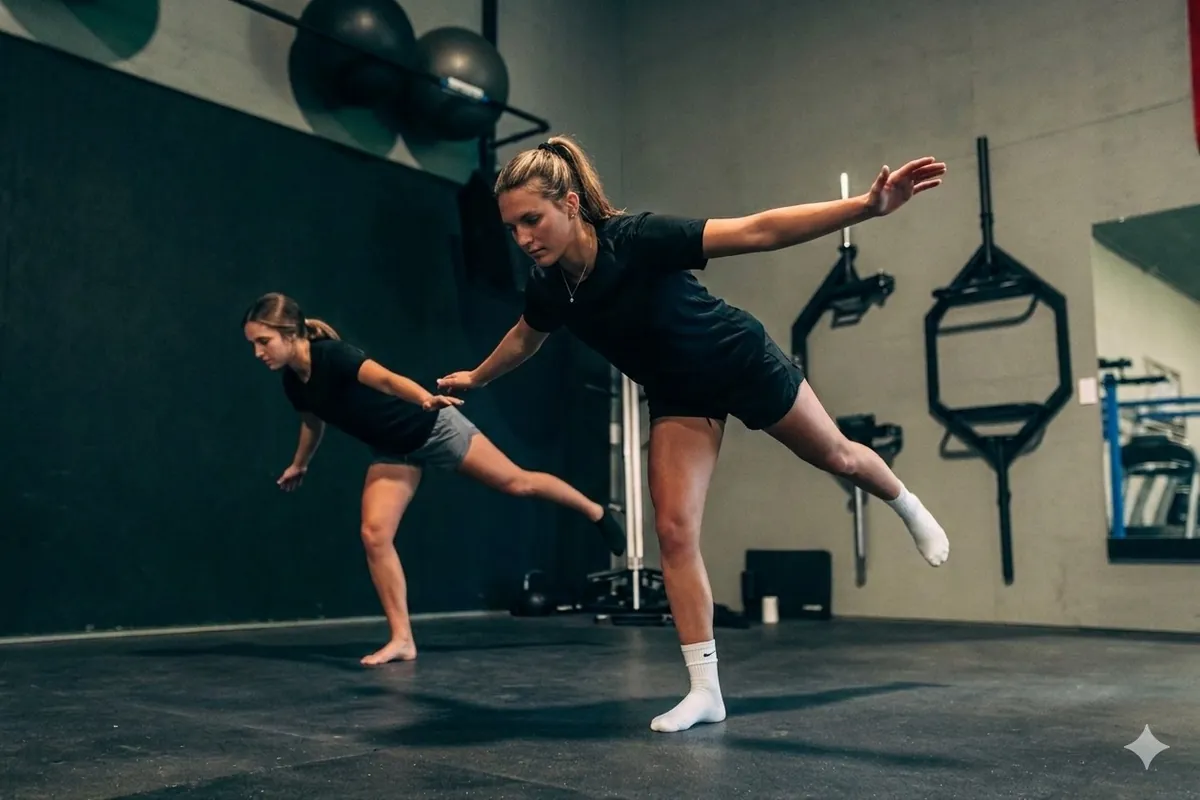
Volleyball players jump higher and hit harder by training repeatable vertical power, not just a single max-effort jump, alongside shoulder durability and landing mechanics that hold up over hundreds of reps in a match. The sport rewards an athlete who can produce the same explosive jump on the fortieth attack as the first, land it safely, and repeat that cycle without breaking down. An assessment identifies whether the limiting factor is power output, shoulder health, or landing control before the program gets built.
Volleyball looks like a jumping sport from the stands, but the real skill isn't one big vertical — it's producing that same explosive jump, attack after attack, set after set, without the shoulder or knees breaking down along the way. That's a completely different training problem than "jump higher," and it's usually the piece that gets missed.
Why Is Repeat Power More Important Than Max Vertical?
A single max-effort vertical jump test tells you almost nothing about how a hitter performs in the third set of a five-set match. Volleyball demands repeated, near-maximal jumps with short recovery windows — hitting, blocking, transitioning — over and over. Training that only chases a one-time peak number misses the quality that actually shows up on the court: the ability to reproduce that power under fatigue.
Building repeat power means plyometric work programmed with real recovery structure, not just max-effort jumps piled on until the athlete is too tired to jump well at all.
The jump that matters isn't the best one in warmups. It's the one in the fourth set.
Why Does Shoulder Care Belong in Speed Training?
Hitting and serving load the shoulder repeatedly, and volleyball athletes who train jump power without addressing shoulder durability often end up limited by pain long before their legs give out. Scapular strength, rotator cuff work, and managed hitting volume aren't optional extras — they're what let an athlete actually use the power they're building.
What Role Do Landing Mechanics Play?
Every jump has a landing, and volleyball players land hundreds of times per match on a hard court, often off-balance or reaching. Poor landing mechanics — knees caving in, landing stiff-legged — are one of the most common non-contact injury risks in the sport. Training landing control isn't separate from training the jump; it's the other half of the same skill.
We see this constantly with volleyball athletes at FPC — a hitter chasing a bigger vertical when the actual limiting factor is a shoulder that can't handle current hitting volume, or landing mechanics that put her at risk every single rep. Fix the real gap and the on-court power follows.
- Repeatable vertical power, trained with real recovery structure — not just max-effort jumps
- Shoulder durability built alongside power, not addressed only after pain shows up
- Landing mechanics trained as deliberately as the jump itself
Which of these is the actual limiter is different for every athlete, which is why an assessment measures power, shoulder health, and landing control separately instead of assuming every volleyball player needs the same jump program.
Frequently Asked Questions
Does volleyball training only need to focus on max vertical jump?
No. Volleyball rewards repeatable jump power across a full match more than a single max-effort vertical, so training needs to build power that holds up under fatigue, not just a one-time peak number.
Why do volleyball players get shoulder pain even with strong legs?
Hitting and serving repeatedly load the shoulder, and jump-power training alone doesn't build the scapular and rotator cuff strength needed to handle that volume, which is why shoulder care has to be trained on purpose.
How important are landing mechanics for volleyball athletes?
Very. Volleyball players land hundreds of times per match, and poor landing mechanics are one of the most common causes of non-contact knee injuries in the sport, so landing control should be trained as deliberately as the jump.
What should a volleyball player prioritize first — jump power, shoulder health, or landing mechanics?
It depends on the individual athlete's limiting factor, which is why assessing power output, shoulder durability, and landing control separately matters more than a generic vertical-jump program.
Start With a Free 45-Minute Consultation.
Start with a free 45-minute consultation about your goals, current training, and what is not improving. If FPC is the right fit, Cody will explain the assessment and next steps.
Book a Free 45-Minute Consultation →