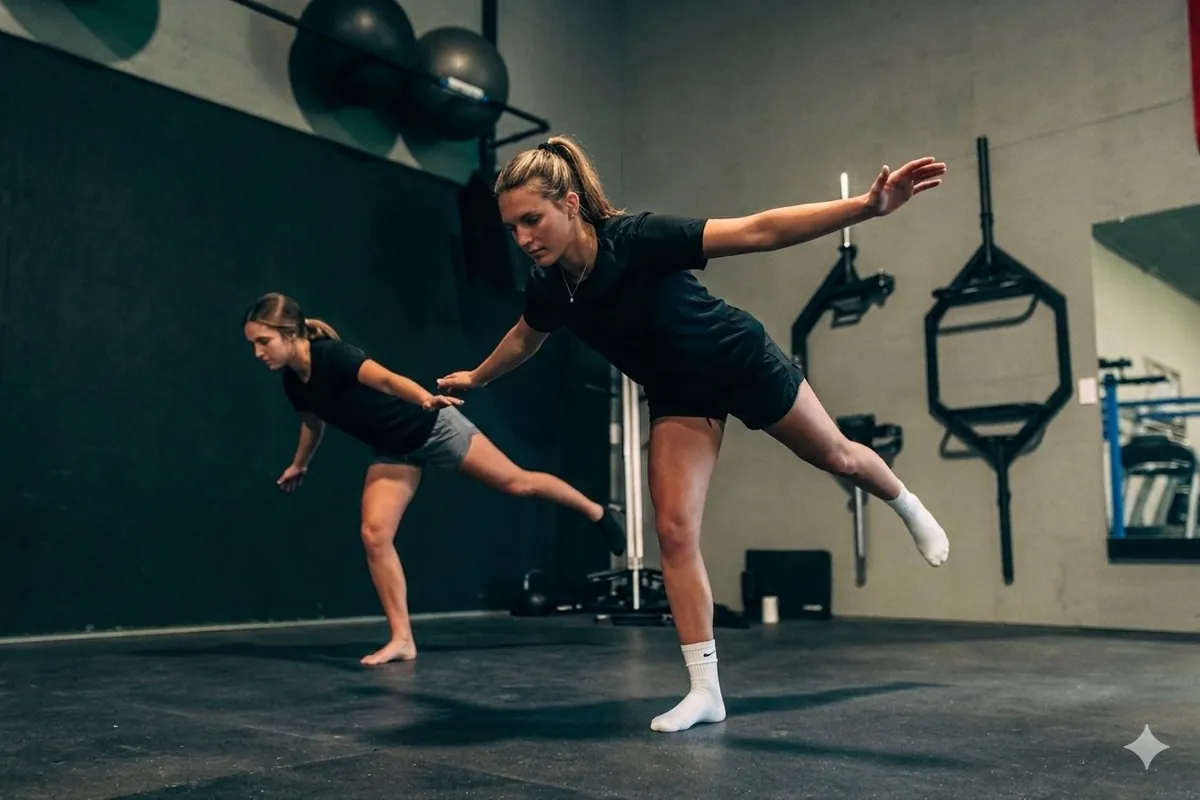
Softball's shorter base paths and pitching distance compress the time an athlete has to produce force, which means rotational power for the swing, first-step acceleration for base running, and arm care for a different throwing motion all need sport-specific training rather than a scaled-down baseball program. Athletes who train softball's actual demands see faster bat speed, quicker steals, and fewer overuse injuries than those following generic programming.
Softball gets treated as a smaller, slower version of baseball more often than it should. The field is smaller, but the time windows are tighter, not looser. Sixty-foot base paths and a 40-to-43-foot pitching circle compress the time an athlete has to react and produce force compared to baseball's longer dimensions. That compression changes what actually needs to be trained.
A flatter, more rotational swing plane, a windmill throwing motion instead of overhand, and base-running windows measured in fractions of a second all demand training built around softball specifically, not a program copied from baseball and scaled down.
Why Does Base Running Need Different Speed Training in Softball?
Because a 60-foot base path leaves almost no room for a slow first step to get corrected later in the sprint. Acceleration mechanics, the first three to five steps out of the box or off a lead, matter more in softball than top-end sprint speed ever will. Athletes who train long-distance speed work are training the wrong part of the sprint for their sport.
Sixty feet doesn't leave room for a slow start. It only rewards a fast one.
What Makes the Softball Swing a Different Power Problem?
The flatter swing plane and quicker pitching distance mean a hitter has less time to generate bat speed than a baseball hitter does, which puts a premium on rotational power, hip-to-shoulder separation trained through the trunk and hips, not just bat speed drills in the cage. Power training that builds this separation shows up directly as faster bat speed without changing swing mechanics at all.
- First-step acceleration training matters more than top-end speed on a 60-foot base path
- Rotational power and hip-shoulder separation work builds bat speed independent of swing mechanics
- Windmill-specific arm care addresses a different shoulder and core demand than overhand throwing
- Lateral and multi-directional speed supports the reaction demands of infield and outfield play
Softball isn't baseball at a smaller scale. It's a different set of physical problems entirely.
Does Windmill Pitching Change the Arm Care Approach?
Yes, significantly. The windmill motion loads the shoulder and core differently than overhand throwing, and pitchers who train arm care built for baseball's overhand pattern are often training the wrong tissue demands. Core and hip stability play a bigger role in windmill pitching than shoulder-focused programs typically account for.
Where Should a Softball Athlete Start?
With an assessment of first-step acceleration, rotational power, and the specific demands of their position, hitter, pitcher, infielder, outfielder, each of which has a different physical priority within the sport. Training softball as its own sport, not a scaled-down version of another one, is where the real gains show up.
Faster off the bag, harder off the bat, and fewer overuse injuries all come from the same place: training built for what softball actually asks of the body.
Frequently Asked Questions
Should softball players train like baseball players?
No. Softball's shorter base paths, closer pitching distance, and windmill throwing motion create different physical demands than baseball, so training built specifically for softball outperforms a scaled-down baseball program.
What speed training matters most for softball base running?
First-step acceleration. On a 60-foot base path there's almost no room to make up for a slow start, so training the first three to five steps matters more than top-end sprint speed.
How can softball players hit the ball harder?
Rotational power and hip-to-shoulder separation training builds bat speed independent of swing mechanics changes, since the flatter softball swing plane leaves less time to generate power than baseball's.
Does windmill pitching require different arm care than baseball pitching?
Yes. The windmill motion loads the shoulder and core differently than overhand throwing, and softball pitchers need arm care built around that specific pattern rather than a baseball throwing program.
Start With a Free 45-Minute Consultation.
Start with a free 45-minute consultation about your goals, current training, and what is not improving. If FPC is the right fit, Cody will explain the assessment and next steps.
Book a Free 45-Minute Consultation →