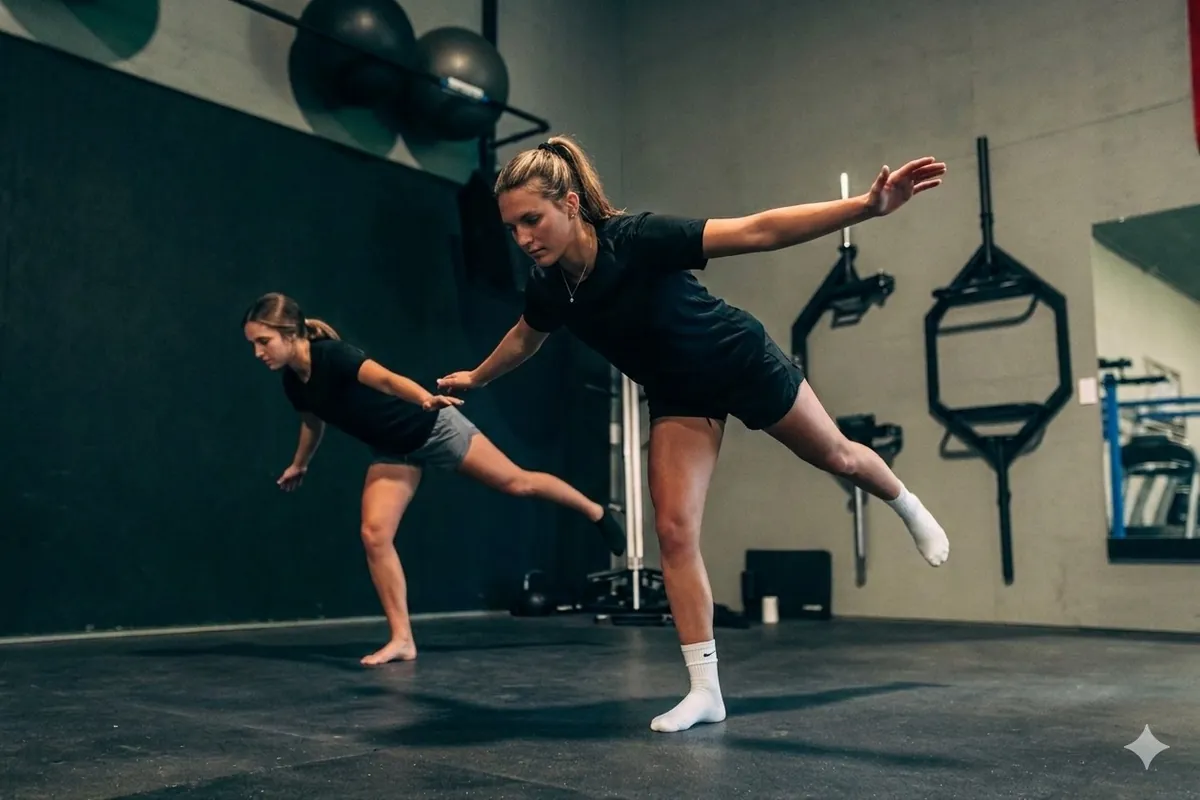
First-step quickness comes from three trainable qualities: acceleration mechanics (getting force into the ground fast, low to the ground), deceleration strength (the ability to stop and change direction without losing power), and reactive ability (reading a defender or a gap and firing without hesitation). Most players only train the first one — sprint drills — and skip the deceleration and reactive pieces that actually decide who beats their man.
Every coach wants "that guy" — the one who gets by his defender before the defender even finishes reacting. Parents ask if it's genetic. It's not, not mostly. First-step quickness is a stack of trainable qualities, and most basketball players only ever train one layer of it.
What Actually Makes a First Step Fast?
It starts with acceleration mechanics — how efficiently an athlete gets force into the floor in the first 2-3 steps out of a stance. Low shin angles, a strong first push, and quick ground contact times matter more here than top-end sprint speed ever will, because basketball rarely gives anyone 40 unopposed yards to build up to max velocity.
But the step before the step matters just as much. A guard has to decelerate out of a dribble move, a cut, or a defensive slide before they can accelerate again — and if that deceleration is weak, the "explosive" first step is really just recovering balance before it can fire.
You can't accelerate out of a position you're still falling into. Deceleration strength is what makes the next step explosive instead of just fast.
Why Do Some Guards Look Quicker Than They Test?
Because basketball speed is reactive, not linear. A player reading a live gap, a shifting defender, or a closing shot clock has to decide and move in the same instant — that's a different skill than running a straight-line sprint test, and it's why some athletes who test fast in a 10-yard dash still look slow in a live game, and vice versa.
- Acceleration mechanics — force application and shin angle in the first 2-3 steps
- Deceleration strength — eccentric control to stop and redirect without losing power
- Reactive training — live, unpredictable cues instead of memorized patterns
The guard who "just has it" spent years building the deceleration strength nobody notices because it happens a split second before the highlight.
What Should a Basketball Player Actually Train?
A mix, weighted toward whatever the assessment shows is the actual gap. Some players need pure acceleration work — stance starts, resisted sprints, short-burst drills. Others already accelerate fine but lose everything on the deceleration and re-acceleration, which points to eccentric strength work — lateral bounds, deceleration-focused sled work, single-leg landing control. Guessing wastes a season; testing tells you which one to prioritize.
Does Strength Training Even Matter for This?
Yes — more than most players assume. Force into the ground has to come from somewhere, and an athlete with no posterior chain or single-leg strength has a ceiling on first-step power no amount of drilling will break through. Speed work and strength work aren't competing priorities for a guard; they're the same project from two angles.
The Bottom Line
First-step quickness is acceleration, deceleration, and reaction stacked together, built on a strength base. Train all three, in the order your assessment says you need them, and "that guy" stops being a mystery.
Frequently Asked Questions
Can first-step quickness actually be trained, or is it mostly genetic?
It's mostly trainable. Genetics set a ceiling, but acceleration mechanics, deceleration strength, and reactive ability are all skills that improve significantly with the right training — most players are nowhere near their genetic ceiling.
Do sprint drills alone improve basketball speed?
They improve linear acceleration, which is part of it, but basketball speed is mostly reactive and involves constant deceleration and redirection — so sprint drills alone leave a big part of game speed untrained.
How does strength training help first-step quickness?
Force into the ground has to come from somewhere. Posterior chain and single-leg strength set the ceiling for how much force an athlete can apply in that first explosive step, so strength work directly supports speed work.
What's the difference between agility and first-step quickness?
First-step quickness is largely about acceleration out of a stance or move; agility adds the reactive, decision-making layer of responding to a defender or opponent in real time. Both matter for guards, and they're trained somewhat differently.
How do you know whether to prioritize acceleration or deceleration training?
An assessment that measures both separately — not just a single sprint time — shows which one is the actual limiter, instead of guessing and training whichever is easier to coach.
Start With a Free 45-Minute Consultation.
Start with a free 45-minute consultation about your goals, current training, and what is not improving. If FPC is the right fit, Cody will explain the assessment and next steps.
Book a Free 45-Minute Consultation →